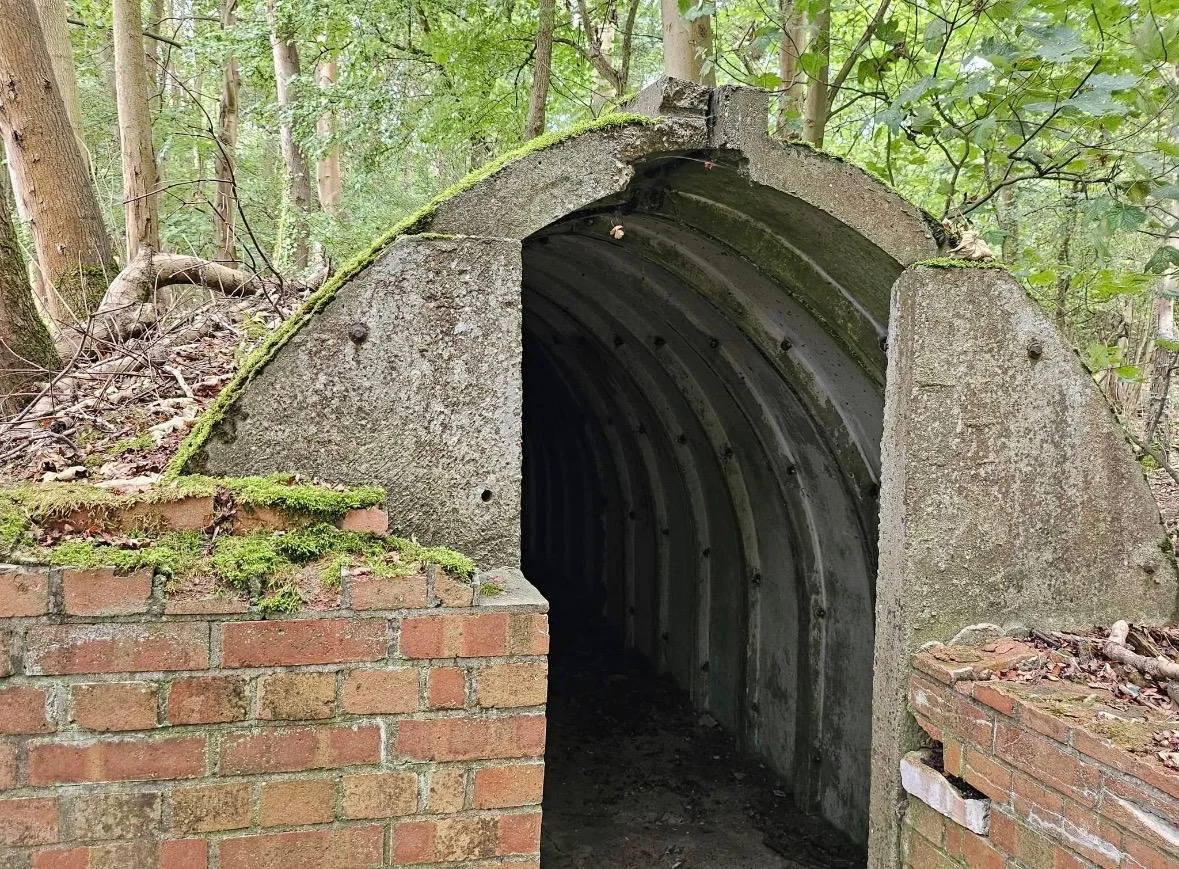
Site 7 - Baseball Pitch
You are now standing at Site 7, where you can see the air raid shelter and the former baseball pitch. While the RAF likely used this area as a football field, the American crews formed their own station baseball team and often practiced right here.
One of those players was Flight Officer Ralph Thomas of Fayette, Iowa, who had played semi-professional baseball before the war. Thomas hoped to represent Ridgewell in the station league and practiced whenever he could. Ridgewell's chaplain, James Good Brown, was an enthusiastic baseball fan who often accompanied the team to its games, and the two men bonded over their shared love of the sport (Brown, 584).
Like many men who played on this field, Thomas was also a combat airman. On 4 April 1945 he was killed in action, only 34 days before Victory in Europe Day. His story is a reminder that for the men stationed here, baseball was never far removed from the realities of war.
The 381st team regularly flew by B-17 to other USAAF bases around Britain to compete in a wider baseball league. Yet the roster continually changed as men completed their tours, were transferred, or were lost on operations.
Air Raid Shelters
Air raid shelters were built to protect personnel in the event of enemy attack. While German intelligence was aware of Ridgewell and even compiled a target dossier of the airfield, the station appears to have escaped the heavy bombing suffered by many other wartime sites, particularly those in and around London.
Later in the war, however, a different threat appeared in British skies: the German V-1 flying bomb, better known as the "buzz bomb" or "doodlebug." An early cruise missile, the V-1 was powered by a pulse-jet engine that produced a distinctive buzzing sound. When that noise suddenly stopped, people knew the bomb was about to fall and explode.
According to Ridgewell's chaplain, James Good Brown, several V-1s came down harmlessly in the surrounding countryside. Brown recalled his first encounter with one in his memoir. Seeing what he believed to be a Spitfire roaring low overhead before crashing into a nearby field in a tremendous explosion, he was horrified. Fearing that a pilot had been killed, he rushed to alert the local vicar, only to be told that it was not an aircraft at all, but a V-1 flying bomb. Relieved that no airman had been involved, Brown never forgot the experience.
Although Ridgewell avoided major bombing damage, the sight and sound of V-1s served as a reminder that the war was still very much on the doorstep of rural Essex.